
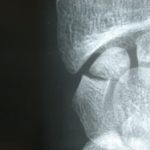
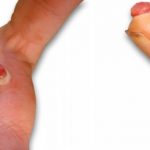
Congenital malformations of the hand” refers to all morphological abnormalities of the hand that are present from birth. This does not necessarily mean that these malformations are hereditary. Simply, the term “congenital” indicates that the malformation occurred during pregnancy. Most often, these anomalies develop during the first two months of pregnancy.
There is a very wide variety of hand malformation types. A classification (known as the Swanson classification), still widely used today, distinguishes 7 different categories. There are malformations due to arrested development (such as the absence of a hand, a finger, a phalanx, or club hands… ), differentiation defects (such as syndactyly, where two fingers are fused together), duplications (such as polydactyly, where an extra finger is added), excessive or defective growth, amniotic flange disease (a group of malformations of the upper and lower limbs) and, finally, malformations due to more general syndromes.
The diagnosis of congenital malformations of the hand is usually made during the obligatory second ultrasound “morphological ultrasound”, performed during the second trimester of pregnancy.
A search for associated malformations is essential.
In order to detect syndromic or genetic forms, it is important to specify
whether the anomaly is isolated or named (cardiac malformation, IUGR, chromosomal anomaly…)
whether the malformation is uni or bilateral
The aim of the therapeutic strategy for congenital hand malformations is to give the child maximum autonomy. This therapeutic strategy may include various treatments.
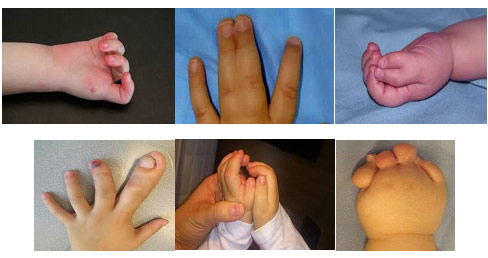
Traitements
- Surgical treatmentSurgical treatment is not automatic. It is decided according to the degree of functional impairment. When surgery is necessary, the technique used obviously depends on the type of malformation. In general, surgery takes place in the first two years of life, i.e. before the child has fully integrated the use of his or her hand. It is usually performed under general anaesthetic. Early treatment before 12 months is generally indicated for polydactylies, syndactylies and severe thumb hypoplasia.
- RehabilitationOccupational and physical therapy sessions are designed to give the child maximum autonomy, by working on his or her functional abilities in various areas of daily life.
- BracesExternal appliances, such as splints, can help with certain deformities. In other cases, prosthesis can be fitted. Appliances can be used on their own, or as a complement to surgery.