

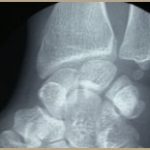
Madelung’s disease is an anomaly that affects both wrists asymmetrically, and is characterized by a “spontaneous and progressive anterior subluxation of the wrist” deformity and posterior subluxation of the tip of the ulna, resulting in a short, curved radius and a long ulna that limit wrist and elbow mobility. It is more common in girls and can be congenital or acquired.
The disease is caused by disorganized growth of the radial epiphysis, leading to its curvature and premature fusion of the conjugation cartilage (epiphysiodesis), with delayed development of the ulna and anterior parts of the inferior radial epiphysis.
Madelung’s disease can occur in isolation, or as part of genetic disorders such as dyschondrosis-nephropathy and brachydactyly type C.
The unilateral form of the disease is rare and generally of post-traumatic origin.
Unilateral or bilateral deformities can be detected on clinical examination in childhood or early adolescence (8 to 12 years).
Clinical description
Mobility is reduced, with limited supination and dorsiflexion, and radial deviation of the wrist. Pronation and flexion, on the other hand, are generally normal. Patients experience a progressive, painful deformity of the wrist.
The diagnosis is made on clinical examination and confirmed by X-rays of the forearm and wrist.
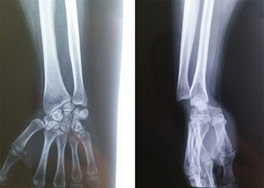
Traitement:
Wrist splints and ergonomic advice can reduce discomfort. In some cases, surgery may be required in children and older children. Osteotomy of the ulna and radius with excision of the Vickers ligament can reduce pain and restore wrist function. Range of motion is generally only marginally improved.
Surgical treatment is not systematic, but varies according to the patient’s age, the severity of symptoms and the desired objectives (aesthetic improvement, pain management, improved range of motion in relation to daily activities and patient expectations), as not all interventions bring the same results.