

Mallet finger is an extremely common condition. It corresponds to the dropping of the last phalanx of the finger (fingertip), with the inability to extend it.
This is due to disinsertion or rupture of the extensor tendon at the base of the last phalanx.

SYMPTOMS AND CLINICAL EXAMINATION
The patient often recounts a minor trauma (e.g. passing the hand under the mattress to make the bed) or a blow from a ball.
The mallet finger doesn’t necessarily hurt, but the patient can no longer lift his finger, and the deformity is typical (the fingertip falls off).
FURTHER TESTS
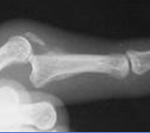
An X-ray of the mallet finger is all that is required. It may show an associated small fracture.
TREATMENT
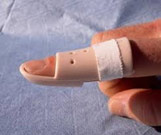
In most cases, mallet finger surgery is not necessary. Treatment consists of splinting the mallet finger in extension. The splint must be kept on day and night for 6 weeks, and then for a further 6 weeks at night only. This is the only way to ensure satisfactory treatment results. Indeed, a slight drop in the fingertip may persist at the end of treatment.
However, a hand surgeon should be consulted, as in some cases (in the case of a large fragment or certain associated fractures, or when splinting fails), surgical treatment is required.
Re-education is not recommended, as it can stretch the tendon scar and lead to a relapse of mallet finger.