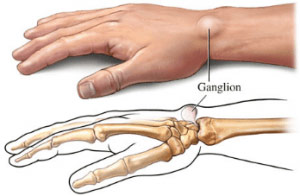
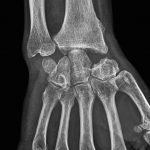

These are swellings formed by a pocket filled with gelatinous fluid, developed in the vicinity of the wrist joint. The most frequent location is on the dorsal and external side of the wrist. More rarely, they develop on the palmar surface of the wrist in the radial pulse groove.
The capsule and synovium form a membrane that holds joint fluid in the wrist joint. This membrane acts as a pocket that can fistulate outside the joint to form a synovial ball – the arthro-synovial cyst of the wrist.
Synovial cysts of the wrist can often appear spontaneously, but they can also occur following trauma or a fall on the wrist, which is unlikely to be serious. Synovial cysts can occur at any age, with the same frequency in both male and female wrists.
In the vast majority of cases, synovial cysts are asymptomatic, but they can sometimes be the source of wrist pain, reduced strength or impaired mobility, particularly in the limited range of motion of the wrist. These symptomatic (painful) cysts may then require wrist surgery. Surgery is sometimes recommended for aesthetic reasons (when the cyst is large and bothersome).
Treatment
Surgery for a synovial (ganglionic) cyst of the wrist is usually performed as an outpatient procedure under local or regional anaesthetic. A mini-incision is made in front of the cyst, allowing it to be extracted. Surgery lasts 30 minutes, after which a dressing is applied and the patient is discharged.
Restriction of intensive hand use for two weeks is recommended.