
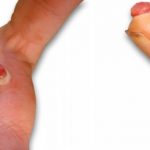

Vicious callus is the consolidation of a bone in an abnormal position after a fracture: there is a deformity of the bone, often visible to the naked eye, as the limb is deformed and movement may be impaired by this complication of the fracture.
Fractures of the lower end of the radius are the most common cause of callus of the wrist. They may be extra-articular or articular, damaging the cartilage and leading to more serious consequences.
THE CLINICAL
Clinically, there is functional and aesthetic damage.
- Wrist deformity
- There is often localized pain in the wrist joint, and also on the ulnar side. These pains increase with movement, especially prono-supination, inclination and exertion.
- There may also be tingling in the fingers, especially at night (carpal tunnel syndrome). This pain also exists when pressing on deformities.
- reduced mobility of the wrist, with a change in mobility sector: there may be an increase in extension and a decrease in flexion, or vice versa, depending on the direction of the callus. There is often a reduction in pronosupination, especially supination, which can be very troublesome. Finger mobility and thumb extension may also be impaired.
- Variable reduction in hand-clenching strength.
FURTHER TESTS
- Frontal and lateral X-rays will assess the shortening and deformation of the radius, and the appearance of the distal radio-ulnar joint (the relationship between the two bones of the forearm).
- A CT scan can be used to better assess displaced bone fragments. It can be supplemented by an arthroscanner, which provides a clear view of the joint surfaces (the state of the cartilage) and ligaments that may have been torn during the fracture.
Traitement
Treatment of wrist callus most often consists of an osteotomy in which the radius is cut and restored to normal alignment, and then fixed in place with hardware, often an osteosynthesis plate.
Depending on the strength of the system, a cast may be splinted for four weeks, or the patient may be allowed to mobilize as early as the first week without splinting.
As soon as consolidation is confirmed by X-rays, rehabilitation (of variable duration) can be undertaken to regain maximum movement.
In some cases, problems are confined to pronosupination, in which case surgery is performed on the ulna alone: shortening by resection of the ulnar styloid (Darrach operation) or screwing together the two bones (radius and ulna), removing a cylinder of bone to enable pronosupination movement in a neo-articulation (Sauvé-Kapandji operation).
The aim of wrist callus treatment is to restore pain-free mobility and muscular strength to the wrist, and to avoid complications such as stiffness, tendon rupture and nerve compression (carpal tunnel syndrome). In some cases, the procedure is recommended for aesthetic reasons.
After exploration, your surgeon will advise you on the best treatment for your specific complaints.