

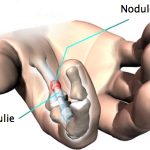
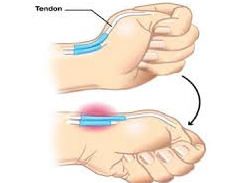
It’s an inflammation of the thumb tendons responsible for pain on the outer edge of the wrist when using the thumb. This inflammation is linked to friction between the tendons of the abductor longus and extensor pollicis brevis of the thumb in its slide on the outer edge of the wrist.
In the vast majority of cases, this pathology affects women around the age of 40 on average (between the ages of 20 and 65). It is linked to repeated movements of the wrist and thumb.

Symptoms and clinical examination
This pathology is responsible for pain on the outer edge of the wrist, aggravated by the use of the thumb. The pain is reproduced by palpation of the outer edge of the wrist opposite the tendons of the abductor longus and extensor pollicis brevis of the thumb. Sometimes a swelling is visible on the outer edge of the wrist, linked to inflammation of the tendons. Pain subsides when the thumb is rested. Finkelstein’s maneuver is used to confirm the diagnosis. This condition is sometimes associated with carpal tunnel syndrome.
Further examination
No further examination is required. Diagnosis is clinical. Ultrasound shows an effusion in the groove and thickening of the tendons. X-rays of the wrist are normal.
In case of diagnostic doubt, an MRI scan may be performed. This shows a hypersignal (white flash) around the thumb tendons.
TREATMENT
Treatment begins with the wrist and thumb resting in a splint, worn at night or during work activities. Painkillers and non-steroidal anti-inflammatory drugs are used if not contraindicated. If this is not effective, hydrocortisone infiltration can be performed. Medical treatment is effective in 90% of cases.
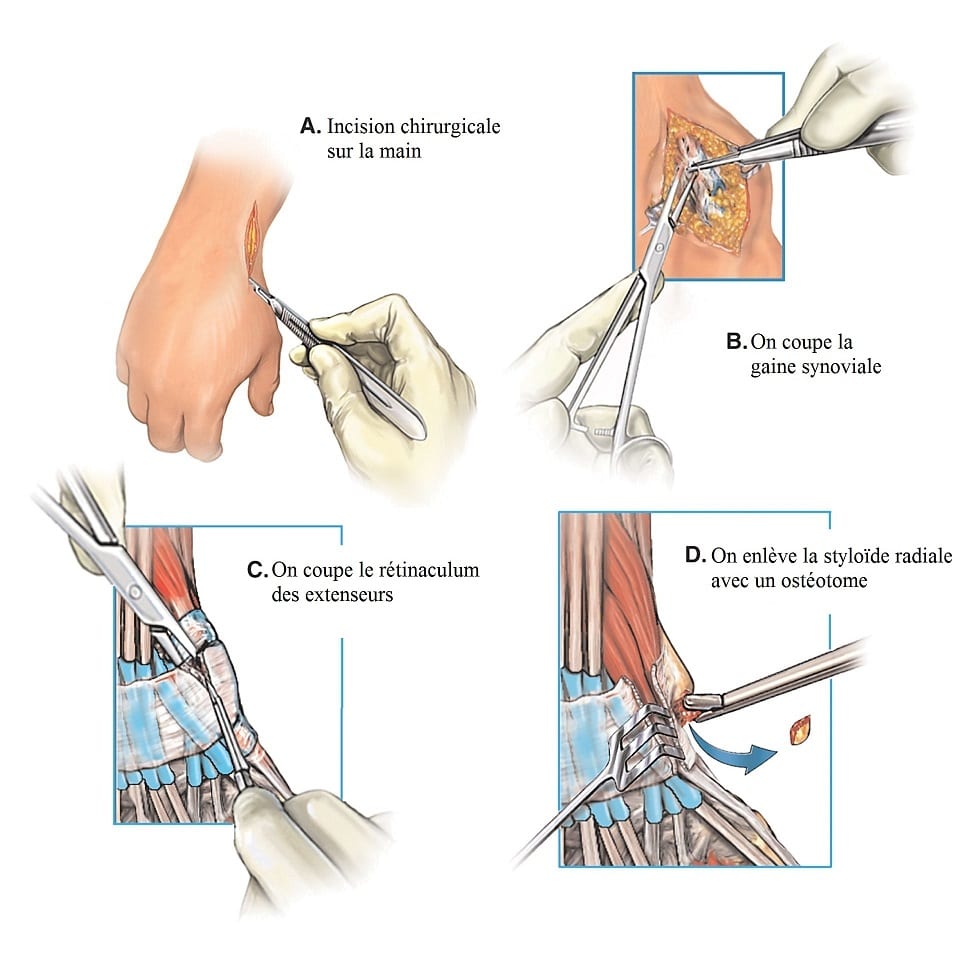
If medical treatment fails after 6 months, surgery may be considered. The procedure involves opening the slide on the outer edge of the wrist, enabling the tendons of the abductor pollicis longus and extensor pollicis brevis to slide. The procedure is performed on an outpatient basis (the patient does not sleep in hospital), under local or locoregional anesthesia (general anesthesia is used only if local anesthesia is contraindicated, or if the patient so wishes). The incision measures 2 cm along the outer edge of the wrist.
POST-OPERATIVE FOLLOW-UP
The patient is discharged from the clinic with a dressing to be changed twice for 2 weeks (skin healing time). The patient mobilizes the fingers immediately after surgery. A removable wrist splint for the thumb should be worn for 3 weeks. Tendonitis pain subsides rapidly. Healing is achieved in 90% of cases by the 3rd postoperative month.
Complications
Complications are very rare. Healing is incomplete in 10% of cases, with persistent pain. There is also a risk of damage to the sensory branches of the radial nerve, resulting in tingling on the back of the hand. Compression often recovers completely after a few weeks.