


Clinical translation of median nerve compression at the wrist. At this point, the nerve passes through an inextensible tunnel with the tendons of the fingers.
This nerve provides sensory (thumb, index finger, middle finger and half of the ring finger) and motor (muscles at the base of the thumb) input to the hand. The nerve and flexor tendons pass through a bony canal (the carpal tunnel), which is covered by a thick ligament (the anterior annular ligament). Any increase in pressure in the carpal tunnel causes the nerve to suffer.
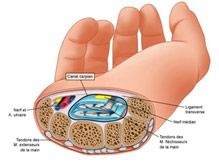
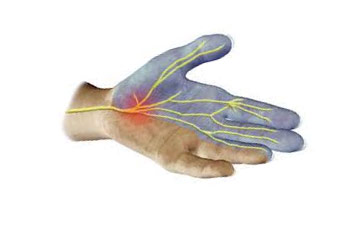
This pathology mainly affects women around the age of 50 or pregnant women, but can also be found in men and young people. The first symptoms are tingling in the fingers, numbness in the first three fingers of the hand (thumb, index and middle fingers) – all signs associated with this obstacle in the path of the nerve impulse – and sometimes a sensation of electric discharge. Disorders are more likely to occur at night. During the day, they occur with certain movements or if the hand has been left in the same position for a long time.
Carpal tunnel syndrome is diagnosed clinically.
An ELECTROMYOGRAM examination confirms the diagnosis and indicates the degree of damage (damage to thumb muscles).
Depending on the degree of compression, two treatments may be proposed:
- Medical treatment :
At the onset of clinical signs: Combination (analgesics – anti-inflammatories) and vitamin therapy with intermittent wrist immobilization.
Corticosteroid infiltrations “with a maximum of 3 sessions” can relieve tingling for a variable period of “3 to 6 months in general”.
If the clinical signs persist or worsen after well-administered medical treatment, surgical treatment is recommended.
- Surgical treatment :
The aim of this procedure is to remove compression by sectioning the roof of the carpal tunnel.
Several types of anesthesia are available: rarely general anesthesia, often plexus block or local-regional anesthesia.
Two surgical techniques are possible: the incision is made in a natural fold of the wrist or hand. Comfort and aesthetics are thus combined for rapid rehabilitation of hand use.
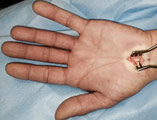
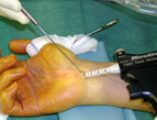
The procedure is performed on an outpatient basis, with a half-day hospital stay.
After the operation, nocturnal tingling generally disappears after the first night. On the other hand, when there was a reduction in sensitivity during the day, the symptoms often only disappear after several months, due to the slow recovery of the nerve.