
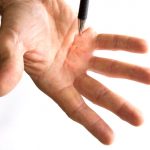
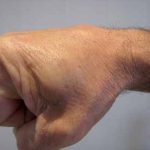
Rhizarthosis is osteoarthritis of the base of the thumb. It affects the joint between the trapezium and the first metacarpal.
It’s a common problem, particularly affecting women in their fifties, and often on both sides at different clinical and radiological stages.
Sometimes osteoarthritis is the consequence of a fracture, rheumatism or infection. But more often than not, the exact cause of osteoarthritis is unknown. It is said to be idiopathic.
SYMPTOMS OF RHEUMATOID ARTHRITIS
The usual symptom is pain, particularly in everyday gestures using the pollici-digital pincer (i.e. the thumb with another finger), such as turning a key, opening a jar or opening a window.
Gradually, the joint deteriorates, then becomes subluxated, leading to the appearance of a characteristic “Z-shaped thumb” deformity at the base of the thumb.

ADDITIONAL EXAMINATIONS
Front and side X-rays of the thumb (Kapandji-incidence) confirm the clinical diagnosis and assess the extent of joint destruction, while preserving a certain amount of bone volume.
Traitement
Initially, treatment is always conservative and medical, combining rest, anti-inflammatory medication and a custom-made thermoformable plastic splint to keep the thumb in the correct position, worn at night.
Pain-relieving and anti-inflammatory re-education (electrotherapy, ultrasound) and possibly infiltration can be tried.
If this treatment is not sufficiently effective over a period of 6 months to 1 year, surgery may be considered. Two main types of operation are proposed, depending on age, joint destruction, work and dominant side, and the surgeon’s habits.
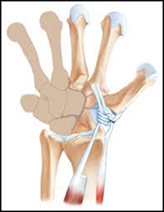
Trapezectomy involves removing the diseased bone. To stabilize the thumb, a ligamentoplasty is usually performed, i.e. the use of a nearby tendon threaded through the base of the first metacarpal.
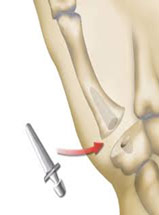
Trapezo-metacarpal prosthesis. This prosthesis resembles a mini hip prosthesis, with a spherical metal head that articulates in a polyethylene or metal trapezoid cup. The prosthetic parts are secured in the bone either by bone regeneration (unsealed prosthesis) or cement (sealed prosthesis).
SPECIFIC RISKS
Whatever the technique, the risks are virtually identical: skin nerve irritation, infection, loosening of the prosthesis.
These problems are exceptional and usually leave no after-effects if treated in time.
POST-OPERATIVE CARE:
You will leave the clinic the same day or the day after the operation, wearing a splint to keep your thumb “apart” to avoid pain and facilitate healing.
You will return for a consultation with your surgeon on day 7 to check the scar.
Re-education will begin sooner or later, depending on the type of operation:
- As early as day 8 for prosthesis
- After 3-4 weeks in the case of trapezectomy with tendon interposition
Full recovery may take 3 to 6 months.