

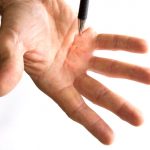
It’s a very common condition, sometimes associated with carpal tunnel syndrome.
Trigger finger is a painful blockage of a finger in flexion. It corresponds to a blockage of the finger’s deep flexor tendon in its sheath (the tunnel through which the tendon passes; flexion of the fingers is made possible by the tendon sliding through its tunnel). The blockage is linked to the thickening of the tendon, which slides less smoothly and eventually jams in its tunnel, sometimes forcing the patient to use his other hand to unblock the finger. The cause of tendon thickening is still unknown. It could be a pathology of the tunnel that causes the tendon to rub, resulting in thickening.
SYMPTOMS AND CLINICAL EXAMINATION
A trigger finger begins with painful discomfort in the palm of the hand at the base of the fingers. This is followed by painful blockages of the finger. As the finger unblocks, it produces a characteristic protrusion that can be very painful. The finger frequently remains blocked in the morning on waking, and the blockages subside during the day. All long fingers and the thumb are affected, and sometimes several fingers on the same hand.
FURTHER TESTS
No further examination is necessary. Diagnosis is clinical. An ultrasound scan is sometimes requested, showing thickening of the tendon and effusion in its sheath. X-rays of the hand are normal.
TRAITEMENT
Shrink-finger can be treated medically or surgically.
The first step is hydrocortisone infiltration, which reduces or eliminates symptoms. Unfortunately, this is only temporary, providing relief from a few days to a few months.
In the event of recurrence or ineffective medical treatment, surgical treatment can cure the condition. This involves opening the tunnel by cutting a pulley (thickening of the tendon sheath) at the base of the finger. This allows the tendon to slide through the tunnel without rubbing. The procedure is performed on an outpatient basis (the patient does not sleep in the clinic) under local or locoregional anaesthetic (general anaesthetic is used only if local anaesthetic is contraindicated, or if the patient so wishes). The incision at the base of the finger measures 1 cm.
POST-OPERATIVE FOLLOW-UP
The patient is discharged from the clinic with a dressing to be changed 4 times for 2 weeks (skin healing time). The patient mobilizes the fingers immediately after the operation. There is no blockage. Post-operative pain is relieved by standard analgesics. Recovery is complete in around 3 weeks.
COMPLICATIONS
Complications arising from a jutting finger are very rare. They mainly involve infection and trauma to the digital nerves, and sometimes algodystrophy.