
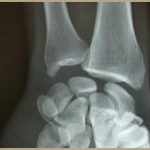

Fracture of the wrist joint components: lower end of the radius for the forearm, upper carpal bones for the hand.
In the vast majority of cases, only the tip of the radius is involved.
This is the classic Pouteau-Colles fracture.
Mechanism
- This fracture is common and can occur at any age.
- It doesn’t require a violent shock to cause it, even in healthy young adults. Typically, all that’s needed is an indirect shock, such as your hand hitting the ground after you’ve fallen from a great height.
- It’s the kind of accident that happens when you slip and land hard on your hand. In sport, all ball activities are affected. But sliding sports are the main culprits: snowboarding, rollerblading, skateboarding…
- This fracture is also indicative of osteoporosis in women. Any woman around the menopause who has a wrist fracture should talk to her doctor to check whether a similar process is underway.
TYPE OF FRACTURE:
- This is the classic Pouteau-Colles fracture, with a transverse fracture line, displacement and posterior tilting of the inferior fragment of the radius, which is usually interlocked with the superior fragment.
- The fracture is almost always closed with no vascular or nerve complications.
DIAGNOSIS:
- The most striking feature is the bayonet-shaped deformation.
- There is always immediate swelling and very specific pain at the fracture site, sometimes with a crackling sensation to the touch.
- X-rays will confirm the diagnosis, but above all the extent of the tilt.
THE TREATMENT
NON OR SLIGHTLY DISPLACED FRACTURES
- Treatment is orthopedic (no surgical intervention). The first step is to reduce the fracture site (under anaesthesia if necessary) by realigning the two fragments.
- The bone is then held in place either by a simple plaster cast, or by the equivalent in resin, taking the hand from the last phalanges up past the elbow. In some cases, splints are used. The surgeon ensures that the wrist is not immobilized in a flexed position, which could present a risk of consolidation in the wrong position. The wrist is usually placed in a neutral position, or slightly extended.
- Duration of immobilization: Between 3 and 6 weeks, depending on the type of fracture.
- Follow-up X-ray in plaster and immediate rehabilitation to restore flexibility to the joint and volume and tone to the forearm muscles.
DISPLACED FRACTURE
When the fracture is very displaced, or if the bone is porous or fragile, other techniques, this time surgical, must be used:
Pins are inserted through the skin, after small, minimal incisions. They are left in place for 6 weeks, often covered by a cast or splint, and removed under local anaesthetic.
This system is reserved for complex fractures.
Screws: reserved for certain fractures.
Plates: the skin is opened under general anaesthetic, the fracture is reduced so that the bones are firmly in place, and screws (single screws or locked screws) are placed in the wrist. This system is reserved for very unstable or complex fractures.
Depending on the type of fracture (displaced, unstable, articular or extra-articular, associated injury), treatment differs.